
Even the people who eat a "high fibre" diet in the Western world are barely hitting the daily target.
I recently read Fiber Fueled by Dr Will Bulsiewicz, and some of the stats genuinely blew my mind. Here are the ones that have stuck with me.
"High fibre" isn't that high
In the studies the book discusses, a high fibre intake was around 25 to 29 grams a day. That's only about the amount we recommend daily. In the Western world, our fibre intake is so poor that even the high-fibre eaters are sitting right at the goal, not above it. In the US, the average adult eats only about 15 grams a day.
Fibre and bowel cancer
Bowel cancer is the second leading cause of cancer death in the US, and the second most common cause of cancer death in New Zealand too. A large body of research links more dietary fibre with a lower risk of developing it.
One study followed 1,575 people who had already been diagnosed with bowel cancer. Among those who increased their fibre after diagnosis, every extra 5 grams a day was linked to an 18% lower risk of dying from bowel cancer and a 14% lower risk of dying from any cause. That's an observational study, so it can't prove cause, but it's an encouraging finding.
Larger studies, including EPIC-Oxford and the Adventist Health Study, have also linked plant-centred diets to a lower risk of cancer. Those diets tend to be lower in sugar, salt and saturated fat too, so fibre isn't the only factor, but it's a big part of the picture.
What the Hadza can teach us
The Hadza of Tanzania are one of the last remaining hunter-gatherer groups, and they give us a window into what our ancestors' diets and microbiomes may have looked like. They're estimated to eat around 100 to 150 grams of fibre a day, roughly ten times what many Americans eat. Their gut microbiomes are far more diverse than those of Americans.
The two-week diet swap
This study is wild. Colon cancer rates are around 65 per 100,000 in African Americans, compared with fewer than 5 per 100,000 in rural South Africans. To see what diet might have to do with it, researchers swapped the diets of 20 African Americans and 20 rural South Africans for just two weeks. The African Americans ate a traditional high-fibre, low-fat diet (around 55 grams of fibre a day), and the rural South Africans ate a typical Western low-fibre, high-fat diet (around 12 grams).
The results...
- African Americans on the high-fibre diet had less inflammation in the colon, made more butyrate (a short-chain fatty acid linked to protection against colon cancer), and produced fewer secondary bile acids, which are linked to colon cancer risk.
- Rural South Africans on the Western diet saw the reverse, with more inflammation and more secondary bile acids.
All of that in just two weeks. It's a small study, but it shows how quickly our gut responds to what we eat.
Losing diversity across generations
Here's another one. In mice, researchers found that a low-fibre diet caused gut microbe diversity to fall with each generation. By the fourth generation, the mice had lost around 72% of their diversity, and adding fibre back didn't fully restore it. That's an animal study, so we can't assume the same happens in humans. But it raises a really interesting question about what a low-fibre diet might be passing on through generations.
What to do about it
The takeaway is of course - back to basics: eat more plants.
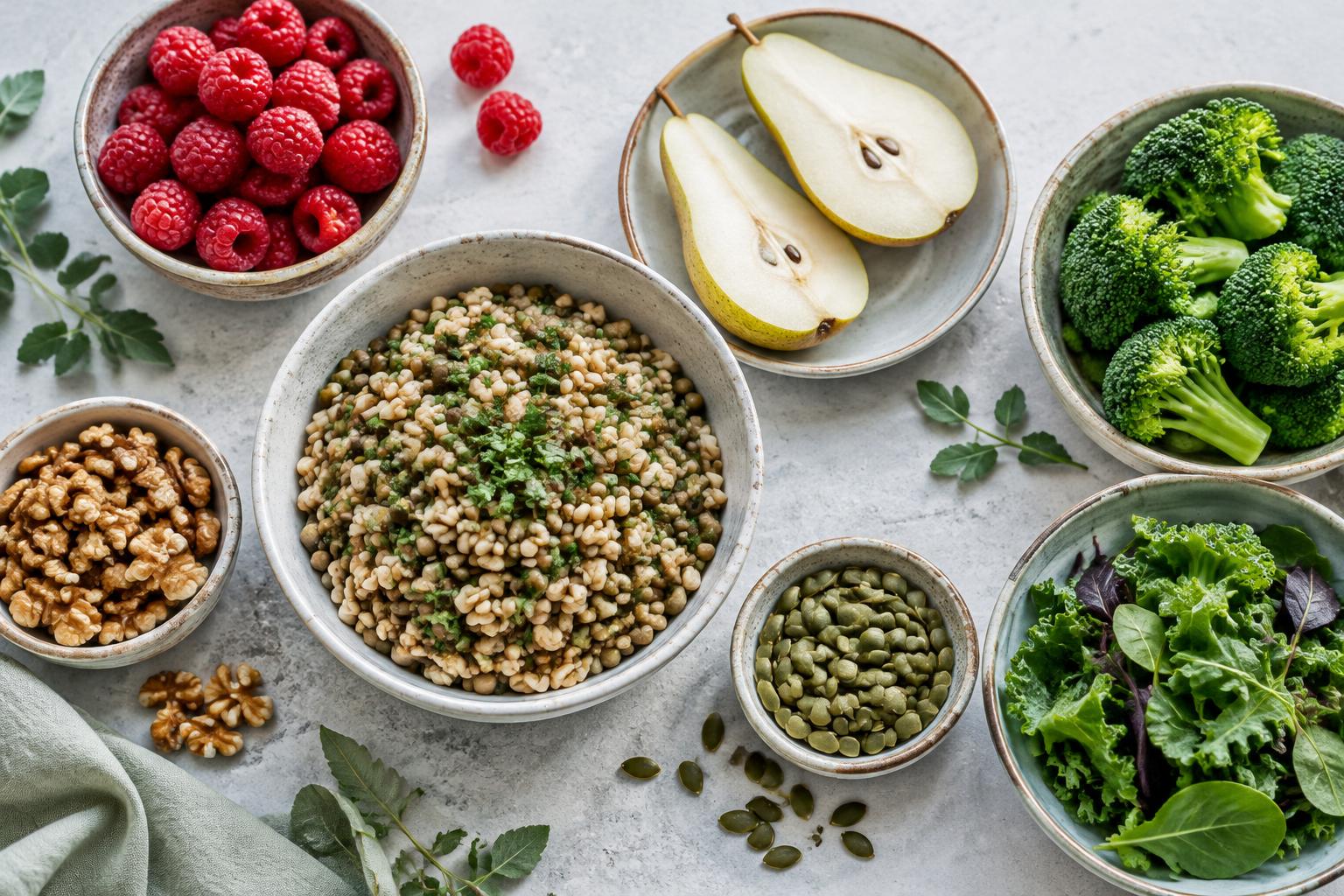
Fruit, veggies, whole grains, nuts, seeds and legumes all contain fibre, so aim for as much variety as you can. And remember to go low and slow when you increase your fibre, and drink plenty of water. I wrote about that in my post, Why Isn't Fibre Sexy?
If you notice blood in your stool or a persistent change in your bowel habits, see your GP, and take up bowel screening if you're eligible.
Sources
- Song M, et al. Fiber intake and survival after colorectal cancer diagnosis. JAMA Oncology, 2018: https://pmc.ncbi.nlm.nih.gov/articles/PMC5776713/
- O'Keefe SJ, et al. Fat, fibre and cancer risk in African Americans and rural Africans. Nature Communications, 2015: https://spiral.imperial.ac.uk/entities/publication/432239b9-af40-4ec2-93b7-5b794a713746
- Smits SA, et al. Seasonal cycling in the gut microbiome of the Hadza hunter-gatherers. Science, 2017: https://www.pbs.org/newshour/science/gut-microbes-found-hunter-gatherers-shift-seasons
- Sonnenburg ED, et al. Diet-induced extinctions in the gut microbiota compound over generations. Nature, 2016: https://www.sciencenews.org/blog/scicurious/low-fiber-diets-make-gut-microbes-poop-out
- Bulsiewicz W. Fiber Fueled.